Science High School Reviewer Physical Science: Matter and Its Properties
Disclosure: This post may contain affiliate links. When you buy through links on my site, I may earn a small commission. Thank you for your support.
The Scientific Method
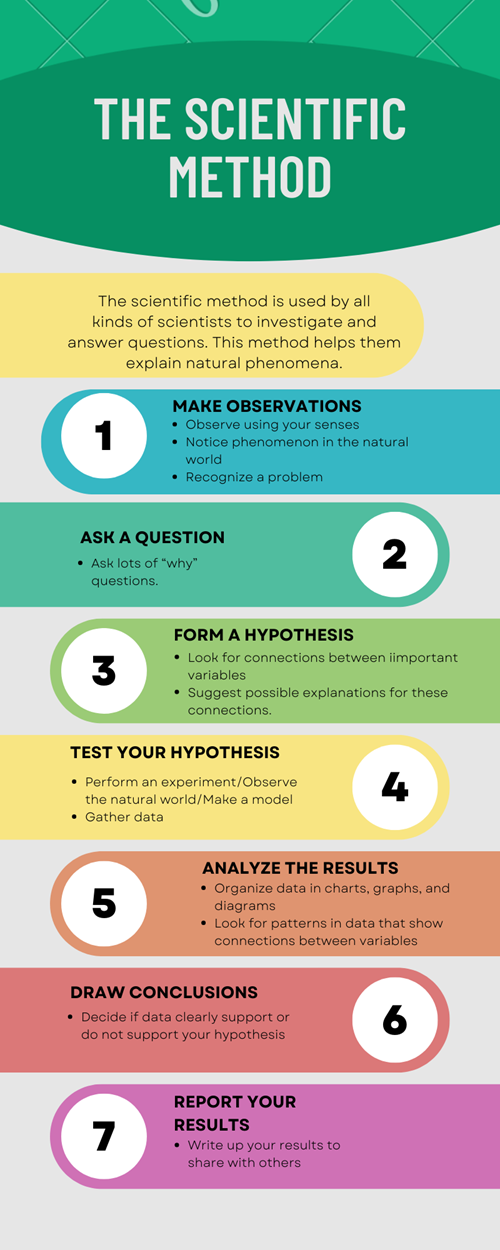
The Scientific Method – A set of generalized steps used to provide answers to questions relating to the natural world. You may encounter a slightly different variation of the steps involved, but they more or less follow the following pattern:
- Make Observations – Observe the world around you using your five senses. Identify a problem or question about the natural world.
- Ask a Question or Identify the Problem – Identify the problem by asking lots of “why” questions. The question needs to be something that can be answered by making observations with your five senses and
- Form a Hypothesis – Look for connections between important variables. Suggest possible explanations for these connections. Make sure the explanations can be tested.
- Test Your Hypothesis – Think about the different kinds of data that could be used to test the hypothesis. Choose the best method to collect this data:
- Perform an experiment (in the lab)
- Observe the natural world (in the field)
- Make a model (on a computer)
- Plan a procedure and gather data. Make sure the procedure can be repeated.
- Perform an experiment (in the lab)
- Analyze the Results – Organize the data as a chart such as a table, graph, diagram, map or group of pictures. Look for patterns in the chart that show connections between important variables in the hypothesis being tested. Make sure to check the data by comparing it to data from other sources.
- Draw Conclusions – Decide if the data clearly support or do not support the hypothesis. If the results are not clear rethink how the hypothesis was tested and make a new plan.
- Report Your Results – Write up your report to share with others.
Matter
Matter is all around us. Matter is anything that has mass and volume.
Mass is the amount of matter in an object. The unit of mass is a gram (g).
Volume is the amount of space that an object takes up. The unit of volume for liquids is a milliliter (mL). The unit of volume for solids is a cubic centimeter (cc or cm3). The two units have exactly the same volume, which means 1 mL = 1 cc or 1 cm3
What isn’t matter? Light and heat do not take up space, and they have no mass. Therefore, they are not forms of matter.
Weight is a measure of how strongly gravity pulls on the object. Weight is measured on a scale as a newton (n) or a gram (g).
Weight and mass are not the same thing.
Weight and mass are not the same thing. A marble will have the same mass on Earth and on the Moon. That is, the amount of matter the marble contains will be the same whether it’s on Earth or on the Moon.
On the other hand, the weight of the marble would be less on the Moon because the gravity of the Moon is weaker than the gravity of Earth.
Physical properties of matter
Volume, mass, and weight are all examples of physical properties of matter. We can sense these properties with our touch, taste, smell, sight, or sound. We can also measure them with instruments such as balances, graduated cylinders, and scales.
The physical properties of matter are properties that can be observed or measured without changing the identity of the substance.
These properties help us tell substances apart.
Density, color, hardness, odor, magnetism, boiling point, buoyancy, and texture are some physical properties.
Density is the measurement of how much mass fits within a certain volume. Density is measured in grams per cubic centimeter (g/cm3). For example, the density of water is 1 gram per cubic centimeter. To find the density of a solid object, divide its mass in grams by its volume in cubic centimeters. Density = mass/volume
Buoyancy is the upward force of a liquid or gas on an object. Buoyancy is a property that helps us build boats.
Chemical properties of matter
The chemical properties of matter can be measured or observed only when matter undergoes a change to become an entirely different substance. These properties include reactivity, flammability, and the ability to rust.
Reactivity is the ability of matter to react chemically with other substances.
Flammability is the ability of matter to burn.
The ability to rust can be observed when iron combines with iron to form rust or iron oxide.
The three states of matter
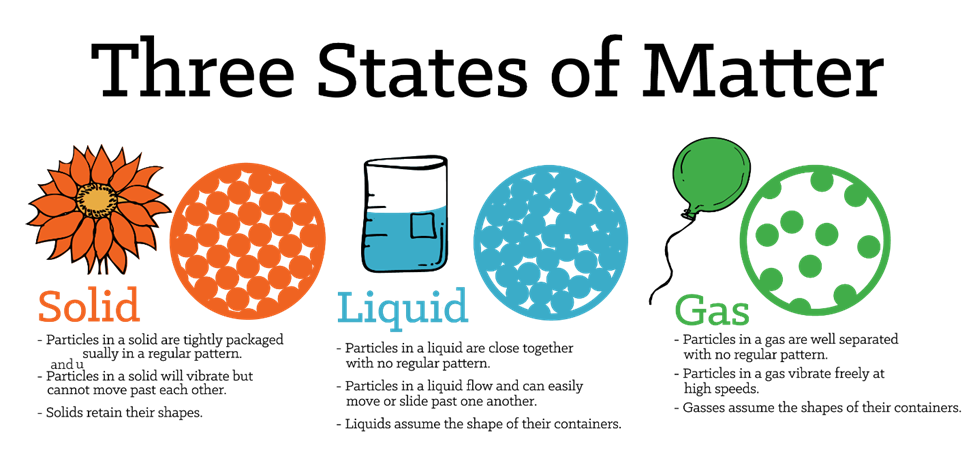
Matter can exist in three states: solid, liquid, and gas.
A fourth state of matter known as plasma occurs at extremely high temperatures. Plasma is found in stars, lightning, and neon lights. Although plasma is common in the universe, it is not common on Earth.
Solid
Properties of solids:
- Solids have a fixed shape and a fixed volume.
- Solids cannot be compressed.
- Solids have a high density.
- Force of attraction between the particles in a solid is very strong.
- The space between the particles of solids is negligible.
Liquid
- Liquids have a fixed volume but no fixed shape.
- Liquids can be slightly compressed. A large pressure is required to compress them.
- Liquids have lesser densities than solids.
- Intermolecular forces of attraction is weaker than solids.
- They have considerable space between the particles.
Gas
- Gases have neither a fixed shape nor a fixed volume.
- Gases can be compressed easily.
- Gases expand to fill their containers
- Gases have the least density among the three.
- Intermolecular forces of attraction is weakest.
- The space between the gas particles is large.
Changing states of matter
Changes of state are physical changes of matter. Matter can change its state when it loses or absorbs energy or heat. Common changes of state include melting, freezing, sublimation, deposition, condensation, and vaporization.
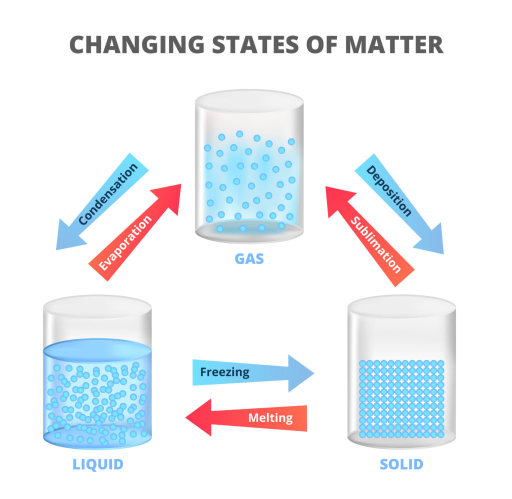
When a solid is heated, its particles vibrate faster and faster. Solids reach their melting point when particles break free and flow past each other.
The melting point is the temperature at which a solid changes to liquid. The melting point of water is 0°C (32°F).
The change of state from liquid to gas is called vaporization. Vaporization can occur in different ways.
When water dries off your hands, it is undergoing evaporation. During evaporation, the fastest particles on the surface of the liquid escape into the air and become a gas. As temperature increases, liquids evaporate faster.
Another way that vaporization happens is through boiling. When water reaches its boiling point, bubbles of vapor form within the liquid and rise to the surface, which allows the gas to escape to the air.
The boiling point is the temperature at which a liquid rapidly changes to gas. The boiling point of water is 100°C (212°F).
When gases cool, their particles slow down and come closer together. At the condensing point, the particles stop flying apart. They form droplets and the gas changes to a liquid. The condensing point of a substance is the same as the boiling point.
As a gas cools, its particles slow down. When particles move slowly enough for their attractions to bring them together, droplets of liquid form. This process, which is the opposite of vaporization, is called condensation.
When the particles of liquids slow down and stop flowing, they have reached the freezing point. The freezing point is the temperature at which a liquid changes to a solid.
The freezing point of a substance is the same as the melting point.
Some solids vaporize without melting in a process called sublimation. During sublimation a solid changes to a gas.
Dry ice is an example of a substance that undergoes sublimation. At room temperature, dry ice changes to gas.
Changes that matter undergoes
Matter is capable of undergoing changes, which are classified as either physical or chemical.
Physical change
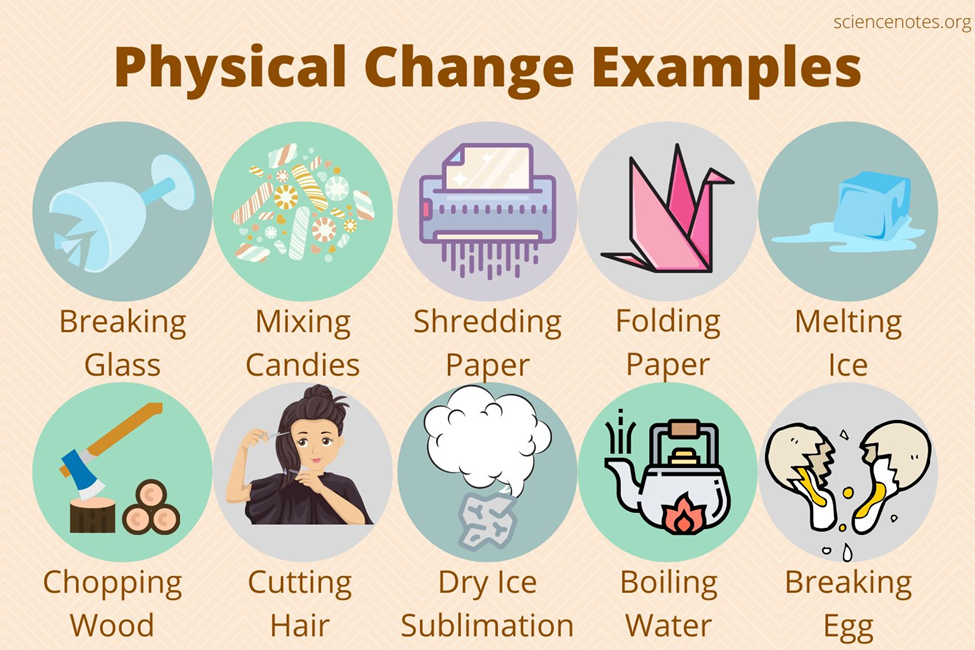
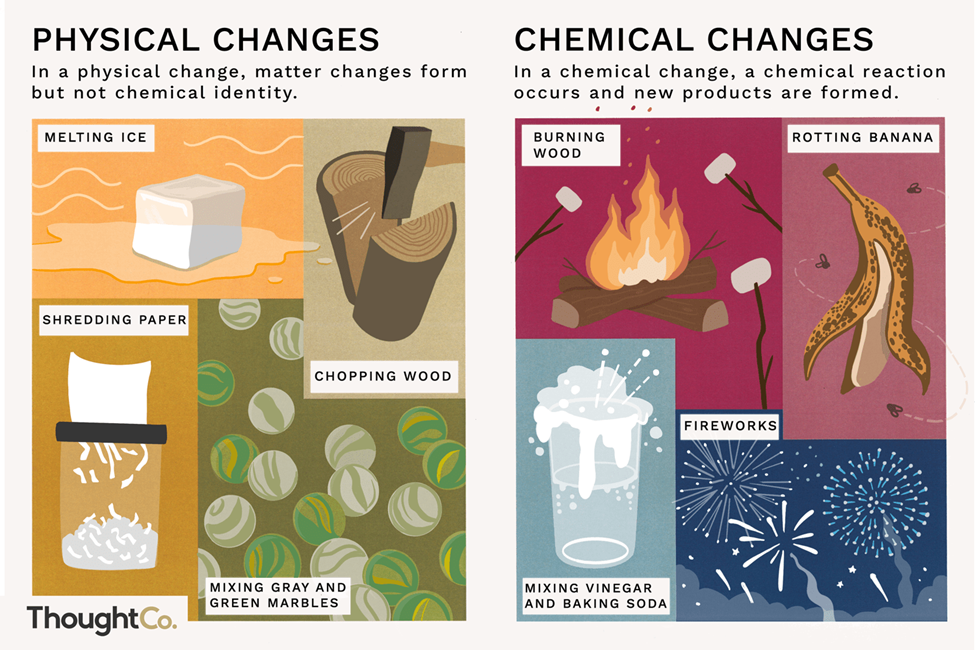
Physical changes in matter are reversible: An ice cube can melt into liquid water, and then the liquid water can be frozen back into an ice cube.
In a physical change, the material involved in the change is structurally the same before and after the change. Types of some physical changes are texture, shape, temperature, and a change in the state of matter.
Chemical change
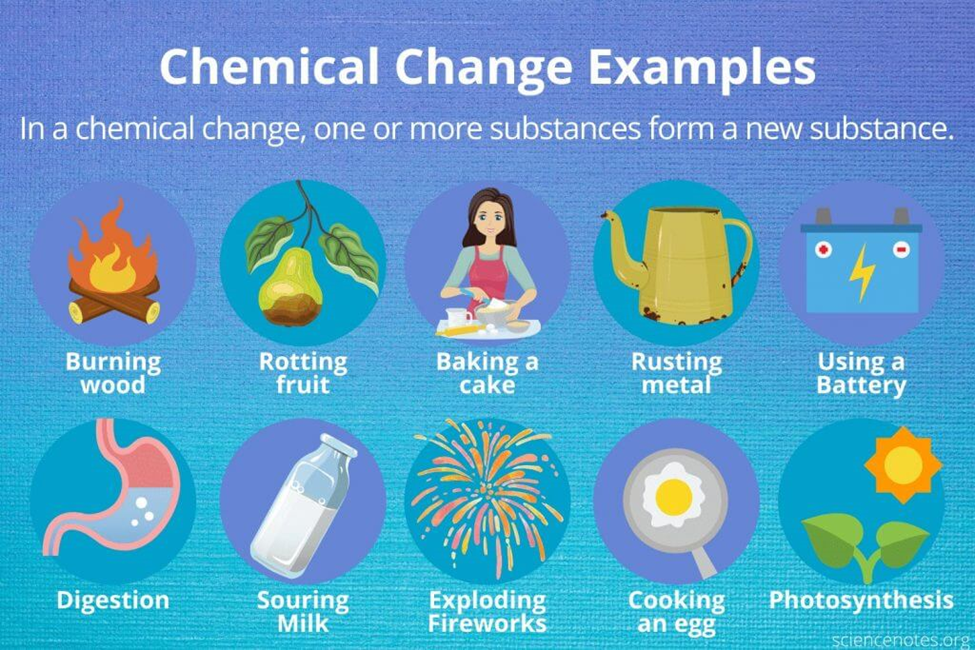
Chemical changes, on the other hand, are not reversible: A log burned in a fire turns to ashes, but the ashes cannot be changed back into a log.
A chemical change occurs when the composition of a substance is changed, which requires the breaking and forming of chemical bonds during a chemical reaction. This results in the rearranging of atoms in substances to form the products of a chemical reaction, which are brand new molecules that cannot be easily reverted back to their original state.
Sometimes it is difficult to tell if a chemical reaction has taken place. To help determine whether there has been a reaction, chemists consider the basic indicators that a reaction has occurred, such as a change in temperature, a change in color, the development of an odor, the formation of a precipitate, or the formation of a gas.
The only sure way to know whether a chemical change has occurred is if a new type of matter is formed that is chemically different from the starting matter. A chemical change cannot be reversed easily. For example, when wood burns, you see it change to ash and gases that have properties that are different from the wood and oxygen that burned. You can’t put the ash and gases back together to make wood. When a cake is baked, changes occur that make the cake batterbecome solid. The chemical change that occurs when baking powder mixes with water results in bubbles that make the cake rise. Raw egg in the batter undergoes changes that make the egg solid. These changes cannot be reversed.
A chemical change produces new kinds of matter. In contrast, a physical change does not produce new matter. New matter has different properties.
Chemical changes take place all around us. Burning wood, rusting iron nails, cooking food and ripening and rotting fruits are chemical changes. Photosynthesis, the process by which plants produce food, is another example. Chemical change also happens in our body. Our body changes food chemically into new matter that it can use as energy.
Energy is always involved in a chemical change. Chemical changes take in or give off energy in the form of heat, light, electricity, sound or motion. For example, heat energy can be added when we light a fire or cook food to produce a new kind of matter. Energy is often released when a chemical change takes place. Burning paper gives off energy in the form of heat and light. An explosion of fireworks is a chemical change. When fireworks explode, they produce many loud sounds and lights.
Acids and bases
You have learned that matter can be described based on its physical and chemical characteristics.
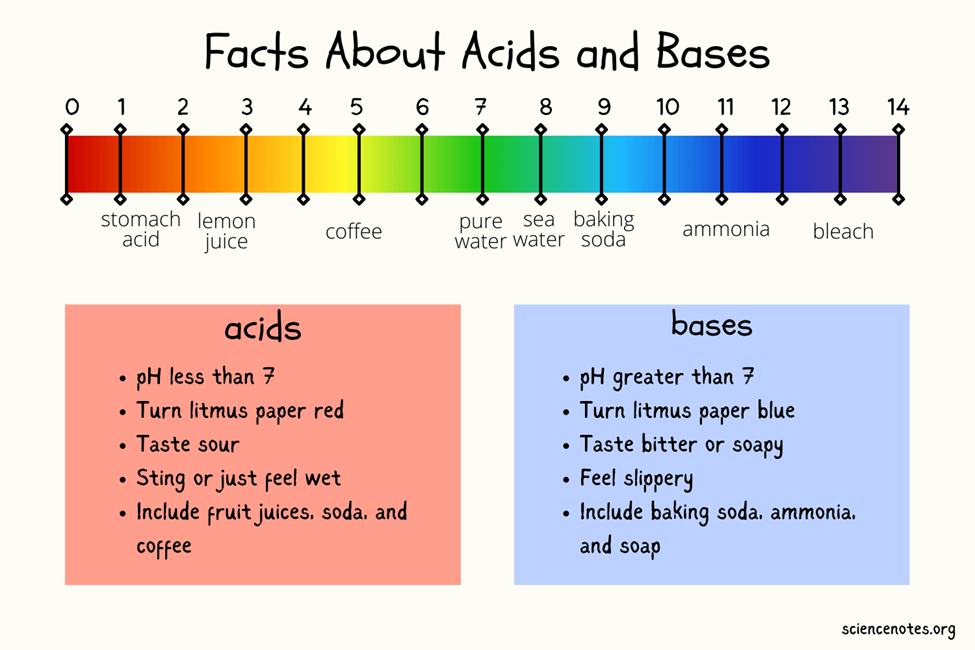
Another way to describe matter is to classify it as either an acid or a base. The concentration of an acid or base can be determined by finding the pH of the sample. The pH scale has a range of 0 to 14. Acids have a pH below 7. Bases have a pH above 7. A sample with a pH of exactly 7 is neutral—neither acidic nor basic. Pure water is a substance with a pH of exactly 7.
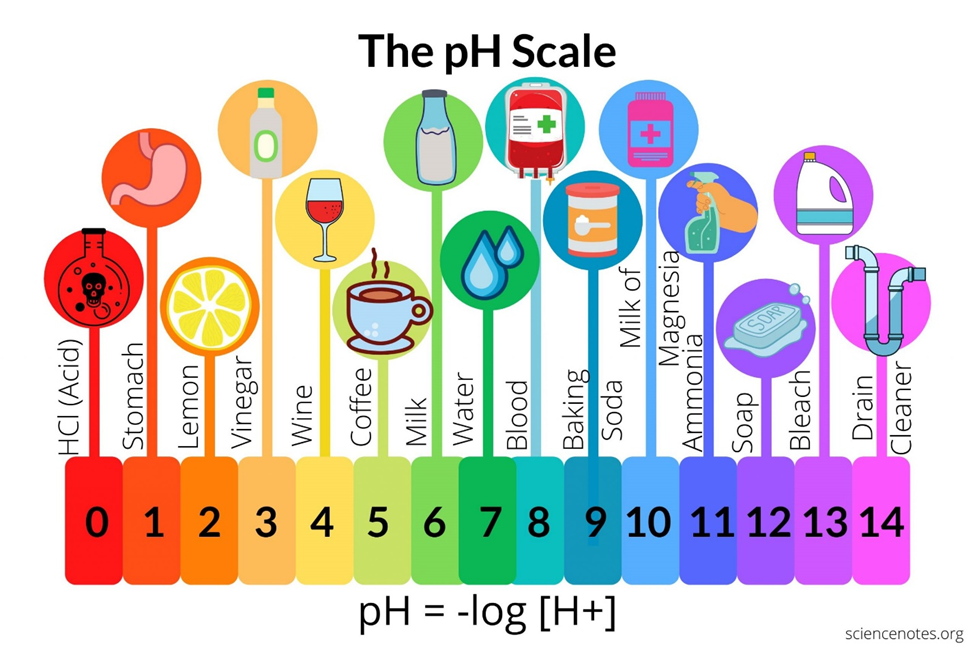
Physical properties of acids – sour taste, sharp smell. Many acids can be hazardous if ingested and should not be tasted. However, some acids are edible, like citric acid and ascorbic acid, which are found in citrus fruits, and carbonic acid, which is used in carbonated beverages. An acid has a tendency to turn blue litmus paper to red.
Physical properties of bases – Bases have a bitter taste and slippery feel. A familiar example of a base is ammonia, which is often used for household cleaning. Another familiar base is soap, which is slippery and tastes bitter (if you’ve ever had soap in your mouth unintentionally). A base tends to turn red litmus paper to blue.

It is important to note that you should never taste, touch, or smell anything in a lab unless your teacher tells you to do so.
Chemical Properties of Acids and Bases
Acids
Many acids react with, or corrode, certain metals. The acids in tomato sauce, oranges, carbonated soft drinks, and other foods are edible. However, many acids can damage plant and animal tissue. Small amounts of nitric acid and sulfuric acid are found in rain. This rain, called acid rain, harms plant and animal life in areas where acid rain falls.
Bases
A concentrated base is as dangerous as a concentrated acid. A base, such as sodium hydroxide can damage living tissue. It is not uncommon for someone who smells strong ammonia to get a bloody nose or to get a burn if a strong base is touched.
Salts
Acids and bases often are studied together because they react with each other to form water and other useful compounds called salts.
Salts are compounds made of a metal and nonmetal that are formed when acids and bases react.
That white solid in your salt shaker—table salt—is the most common salt. Table salt, sodium chloride, can be formed by the reaction between the base sodium hydroxide and hydrochloric acid. Other useful salts are calcium carbonate, which is chalk, and ammonium chloride, which is used in some types of batteries.