Science High School Reviewer Physical Science: Forces and Motion
Disclosure: This post may contain affiliate links. When you buy through links on my site, I may earn a small commission. Thank you for your support.
Motion
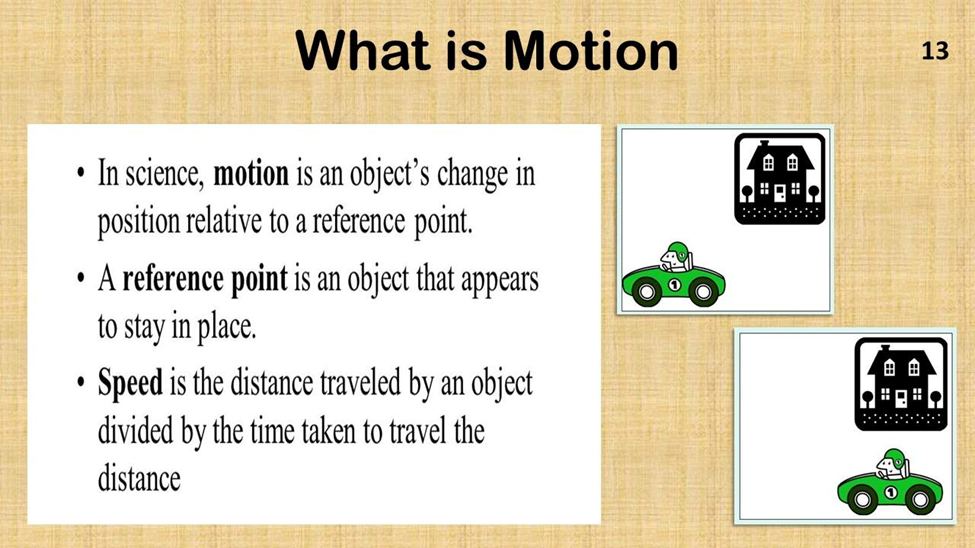
Motion is a change in an object’s position compared to a fixed object. If you ride in a car, your position changes compared to a tree or a telephone pole.
Distance is the length between two places. Using distance and direction can help you identify the position of something. An object’s position is its location compared to other things.
When you ride in a car, the trees and buildings appear to you to move backward. This movement is apparent motion, when things appear to an observer to be moving but are not actually changing position. You use apparent motion to determine what direction you are moving in and to find out how fast you are really moving.
Speed, velocity, and acceleration
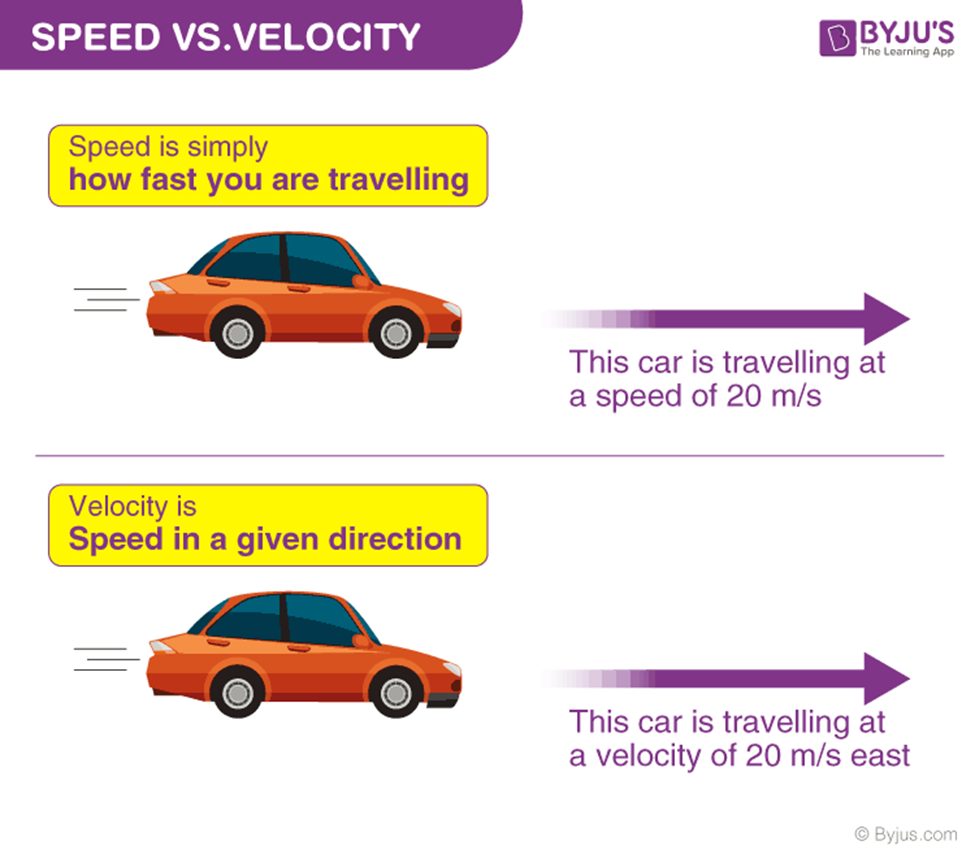
When you describe how fast
something is moving, you are describing
its speed. Speed is how fast an object’s
position changes with time at any
given moment. Speed is calculated by
dividing the distance traveled by the
time taken to travel. A car with a
speed of 80 kilometers (48 miles) per
hour is going faster than a car traveling
at 70 kilometers (42 miles) per hour.
If you know both the speed of an
object and the direction in which it is
moving, then you know the object’s
velocity. Velocity is a description of a
moving object’s speed and direction.
When you know the velocity and
present position of an object, then you
should be able to predict where it will
be located after a certain amount of
time.
Acceleration
If an object travels in a straight
line at a steady speed, its velocity is
constant. Any change in the speed
or direction of an object causes its
velocity to change. Acceleration is
a change in the velocity of an object
over time. Like velocity, acceleration
also has both size and direction. If the
velocity of the moving object increases
with time, then the acceleration is in
the direction of the velocity. If the
velocity of the moving object decreases
with time, then the acceleration is in
the direction opposite the velocity.
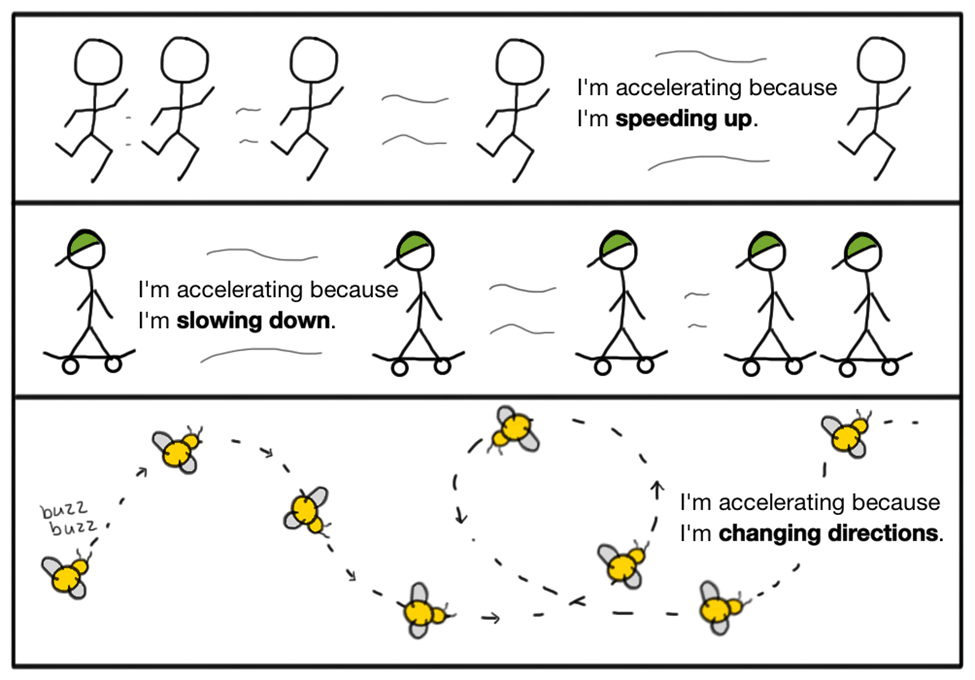
Many people think of acceleration
as an object’s either speeding up or
slowing down. However, an object can
accelerate while maintaining the same
speed. For example, if a car moved at
a constant speed and turned a corner
without changing its speed, the change
in direction would be a change in the
velocity of the car. This means that the
car is actually accelerating.
People who ride on a merry-goround
also experience acceleration.
When the ride begins, the speed of the
merry-go-round increases from zero.
The riders undergo a steady change
in both speed and direction, which is
acceleration, as the ride moves. Once
the ride maintains a constant speed,
the riders continue to accelerate. This
is because they continuously change
direction, even though their speed is
constant. As the ride slows down, the
riders still experience acceleration as
the speed decreases and eventually
reaches zero once again.
Force
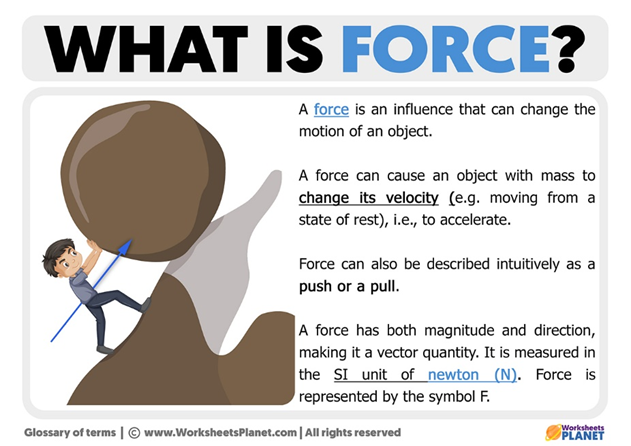
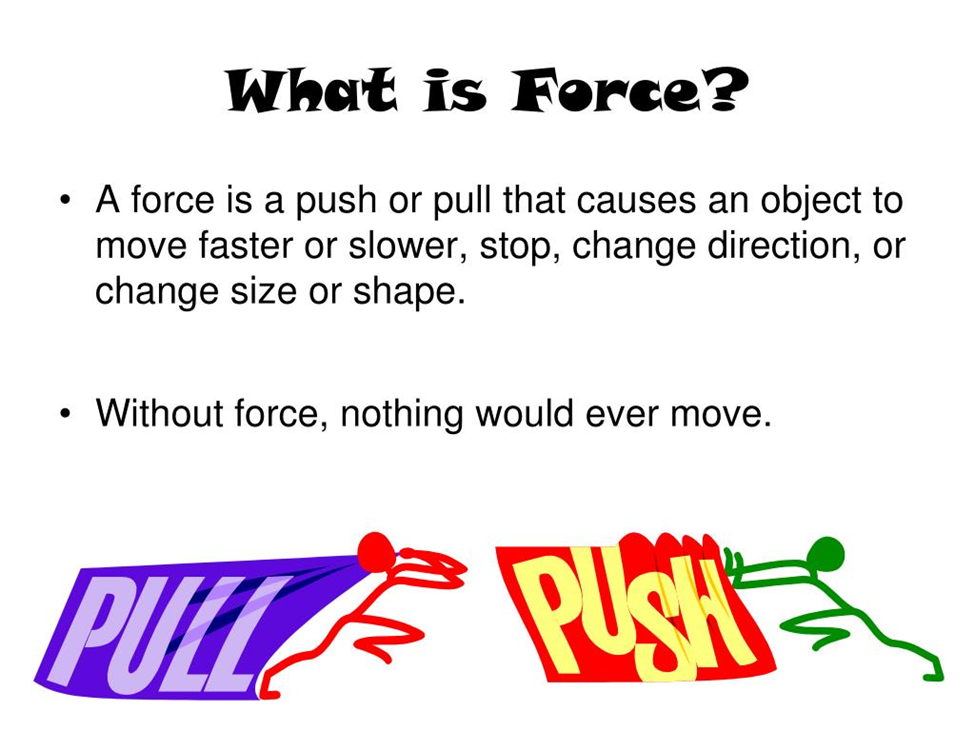
Any push or
pull on an object is a force. Forces can cause
a moving object to accelerate.
Forces can also change the shapes
of objects. When you mold clay,
your hands apply forces that squeeze
the clay into a different, permanent
shape.
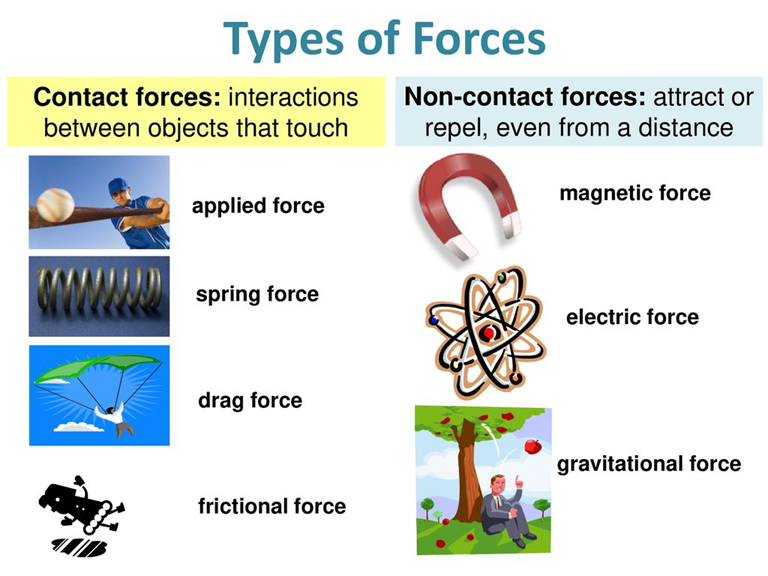
There are different kinds of forces
that push and pull on objects. Buoyancy
is a force that pushes up on floating
objects in a fluid. Magnetic force attracts
or repels certain objects. Gravitational
force is an attraction that exists between
any two objects, such as the gravity that
pulls objects toward Earth.
The metric unit that measures force
is the newton. The force of gravity on a
1-kilogram object is about 10 newtons
(2.2 pounds). A newton produces an
acceleration of 1 meter per second
squared when applied to a mass of
1 kilogram. A spring scale is used to
measure newtons. The spring stretches
when force is applied to it.
Friction
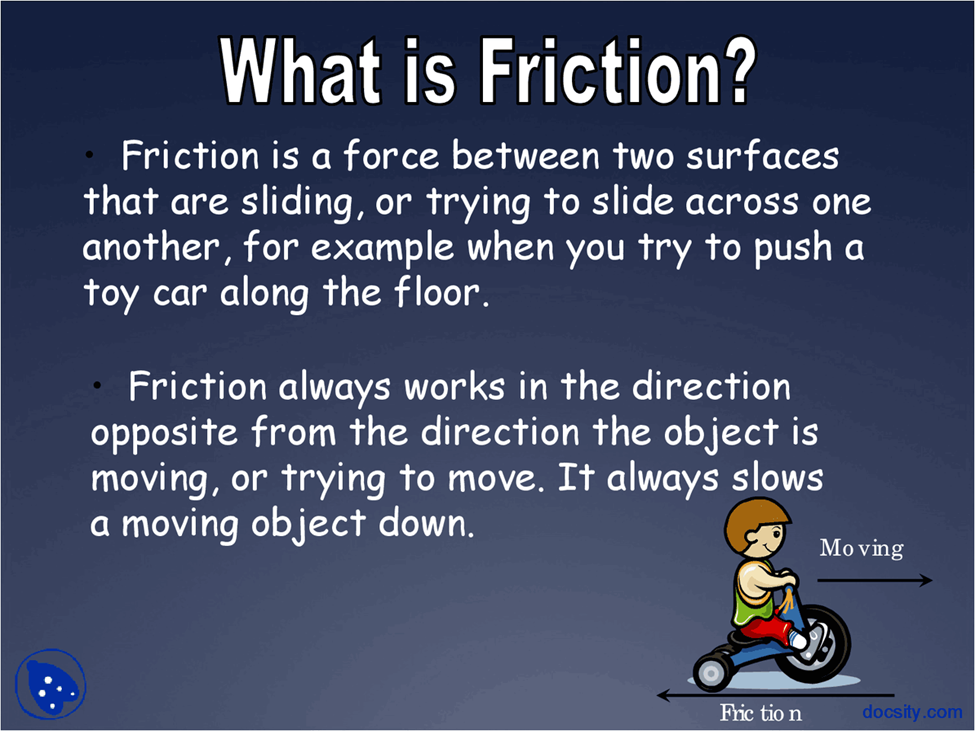
As the book is pulled across a table,
a force works against this movement.
Friction is a force that opposes the
motion of an object. Friction occurs
when two or more objects come into
contact. In order to move the book
across a table, you must pull on it with
a force larger than the force of friction.
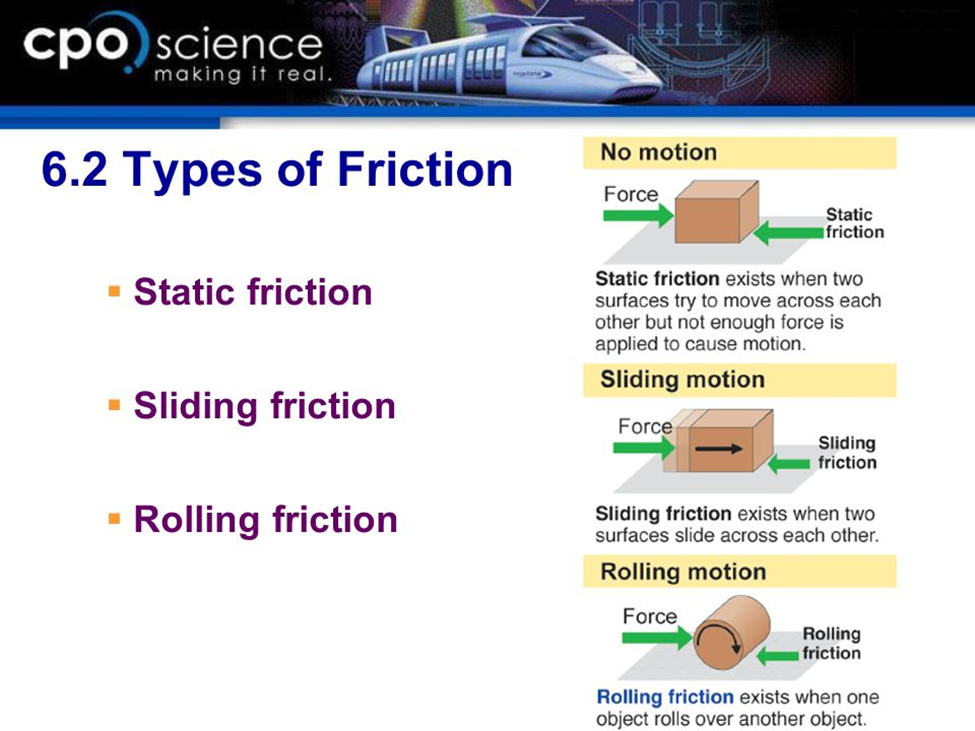
There are many types of friction.
For example, the force between the
surfaces of two solid objects which
keeps the objects from moving is called
static friction. Static friction keeps a
book from starting to move across a
table as a breeze blows through an open
window. Sliding friction is the force that
opposes the sliding of an object over a
surface. You feel sliding friction as you
move a book across a table. The force of
sliding friction is less than that of static
friction. Rolling friction is what opposes
the motion of a wheel turning along a
surface. The force of rolling friction is
less than that of sliding friction.
How do forces affect each other?
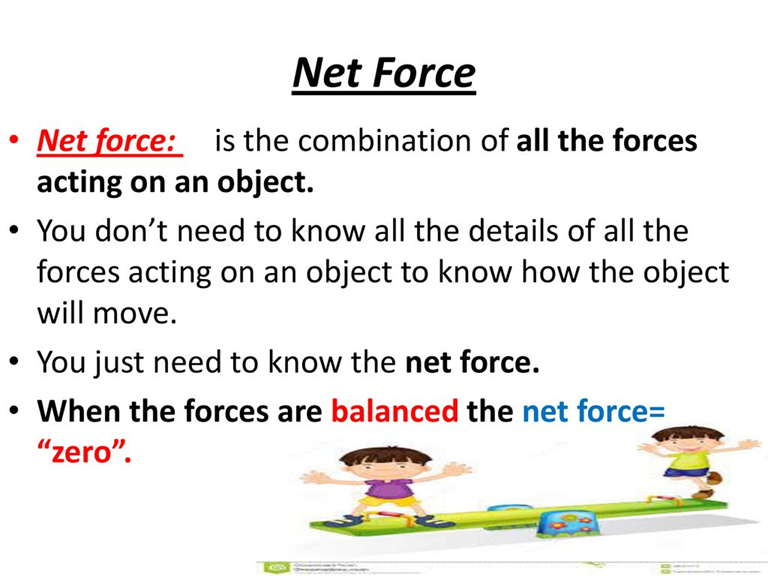
Net force is the sum of all
the forces that are acting on an object.
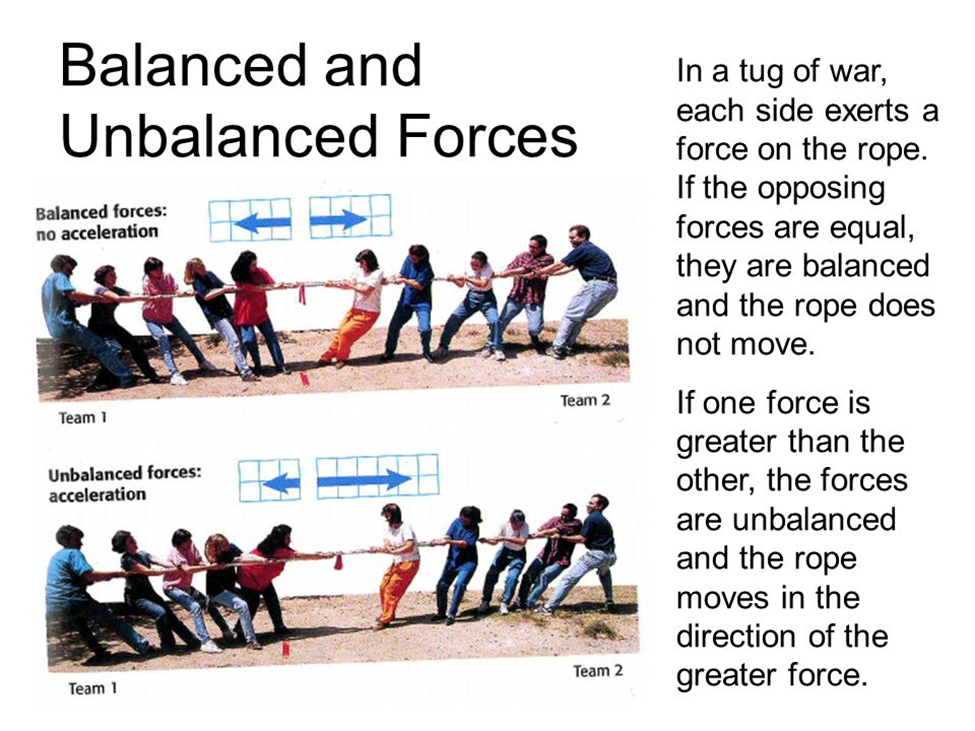
Balanced Forces
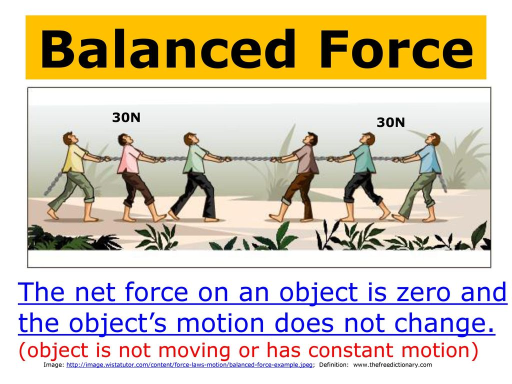
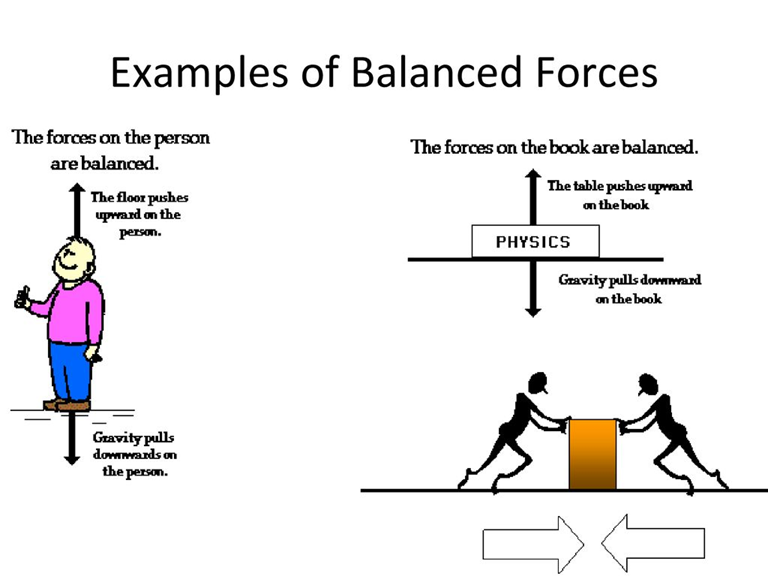
When the net forces are equal in
strength and opposite in direction,
they are balanced forces. The motion
of an object remains unchanged when
forces are balanced. It does not matter
whether the object is motionless or
moving at a constant velocity.
Unbalanced Forces
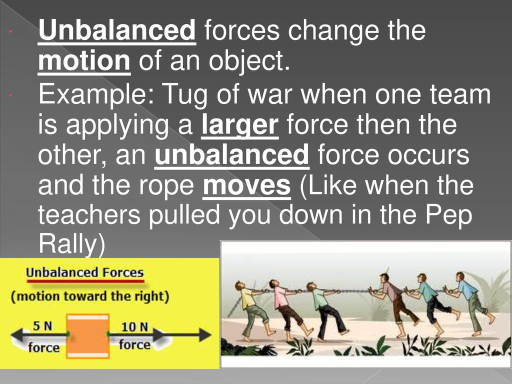
Forces of unequal strength or forces
that are not opposite in direction
are called unbalanced forces.
Inertia
Newton’s Laws of Motion
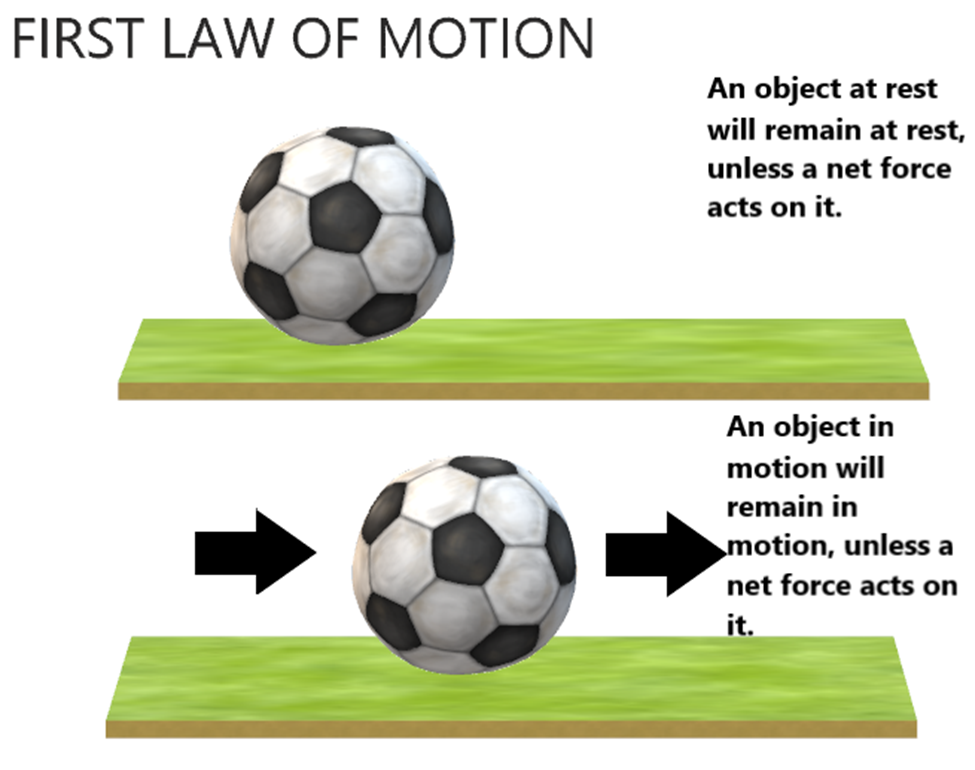
Newton’s first law of motion states
that an object at rest tends to stay at
rest and that an object in motion will
remain in motion. In other words, an
object moving in a straight line at a
constant speed tends to keep moving
that way. According to this law, the way
to change an object’s velocity is to
apply an unbalanced net force to it.
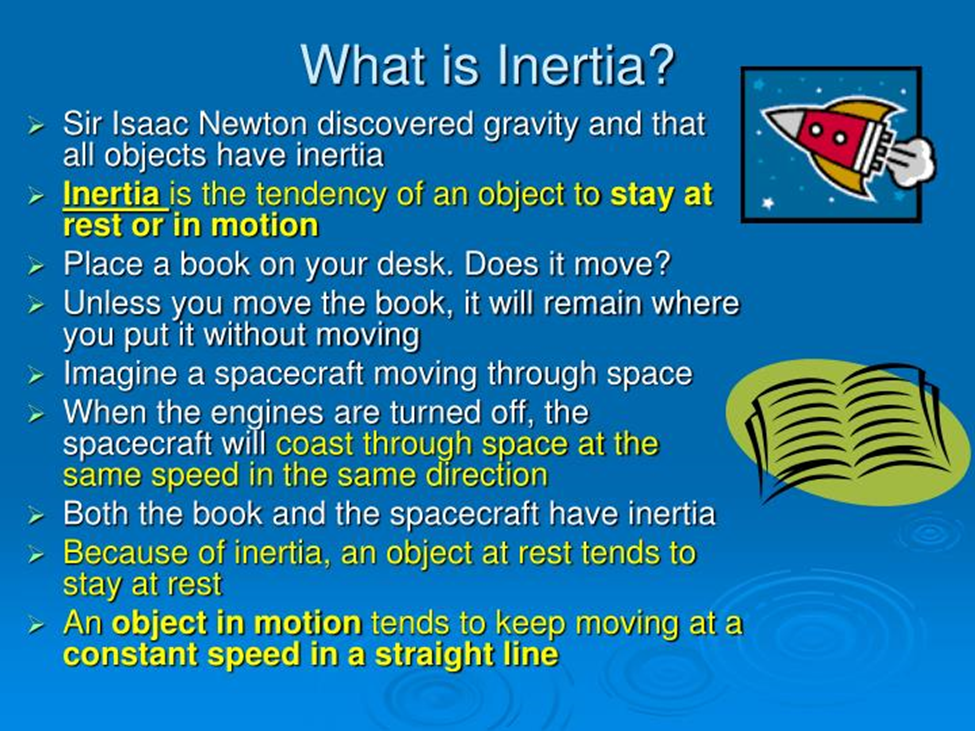
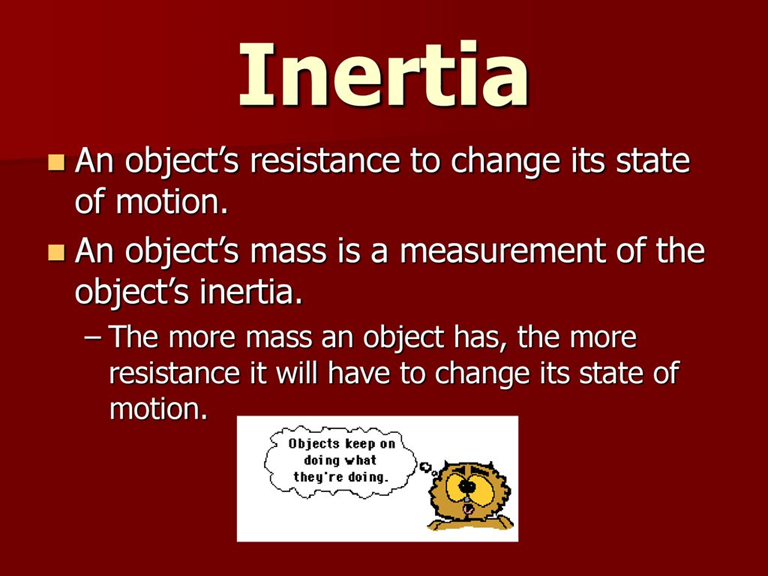
inertia, which
is the tendency of an object to keep
moving at the same speed and in the
same direction.
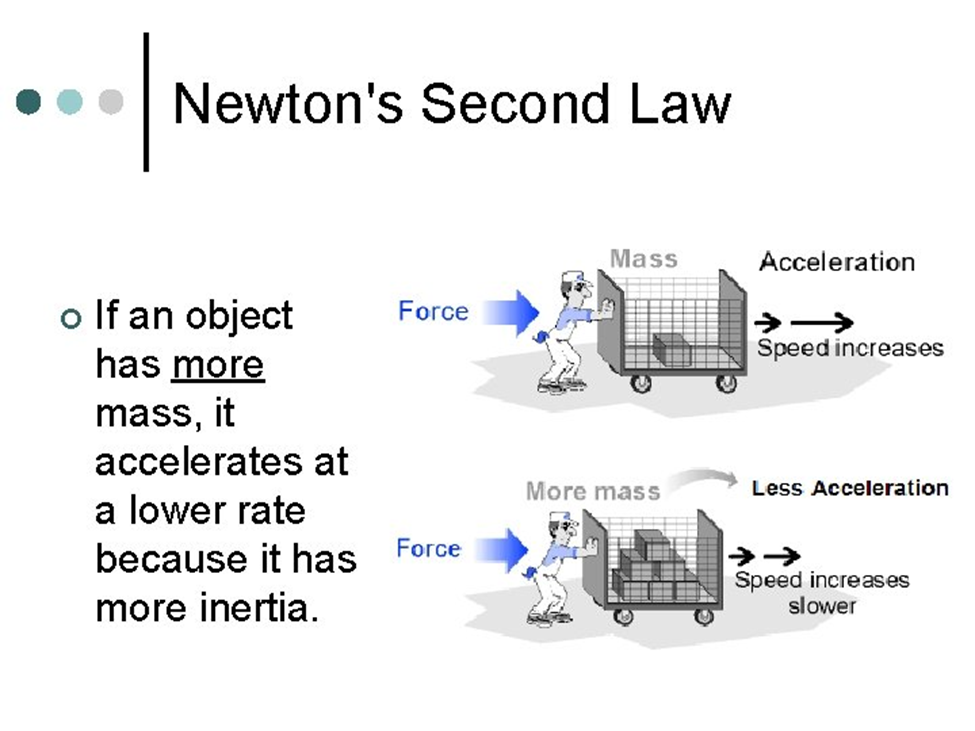
These trials demonstrate Newton’s second law of motion: acceleration depends on the object’s mass and the amount of net force applied to it. Newton’ssecond law can be written as a formula: a = F ÷ m.
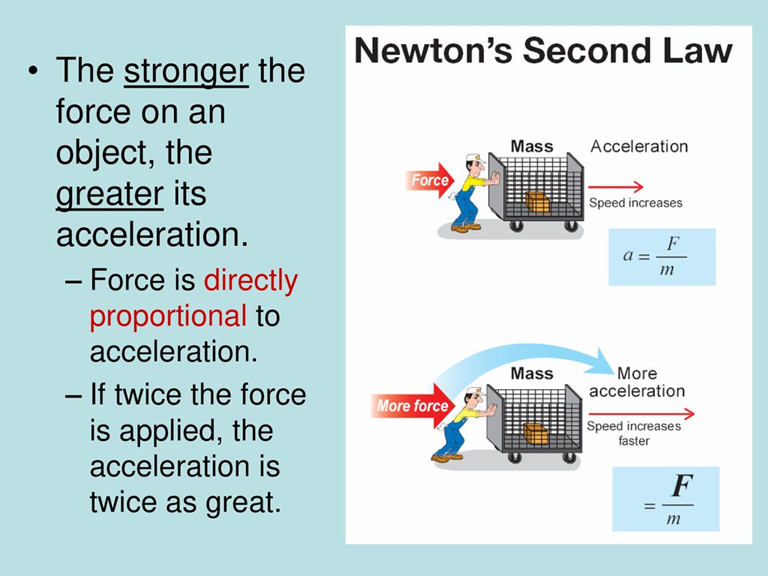
An object’s acceleration (a) equals the
net force on the object (F) divided by
its mass (m). If the force increases,
then the acceleration also increases.
However, if the mass increases, then
the acceleration decreases. Newton’s
first law shows that a net force is
needed in order for an object to
accelerate. Newton’s second law
shows how much acceleration this
net force will cause.
Momentum
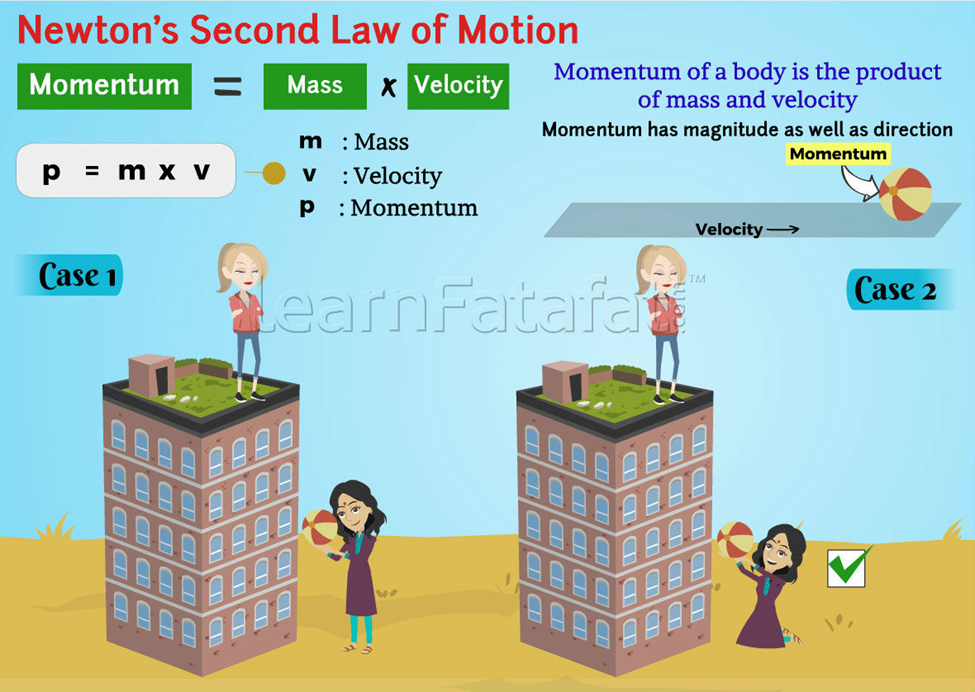
The combination of the mass and
the speed of an object is momentum.
A baseball has more momentum than
a tennis ball traveling at the same
speed because the baseball has more
mass. A tennis ball can have more
momentum than a baseball, if the
tennis ball’s speed is great enough.
Momentum is useful for studying
the motion of colliding objects. Total
momentum does not change when
objects collide. Scientists call this
principle conservation of momentum.
Each
of these situations involves action-reaction
forces. The downward force
a diver puts on a board is an action
force. The upward push that propels
the diver into the air is a reaction force.
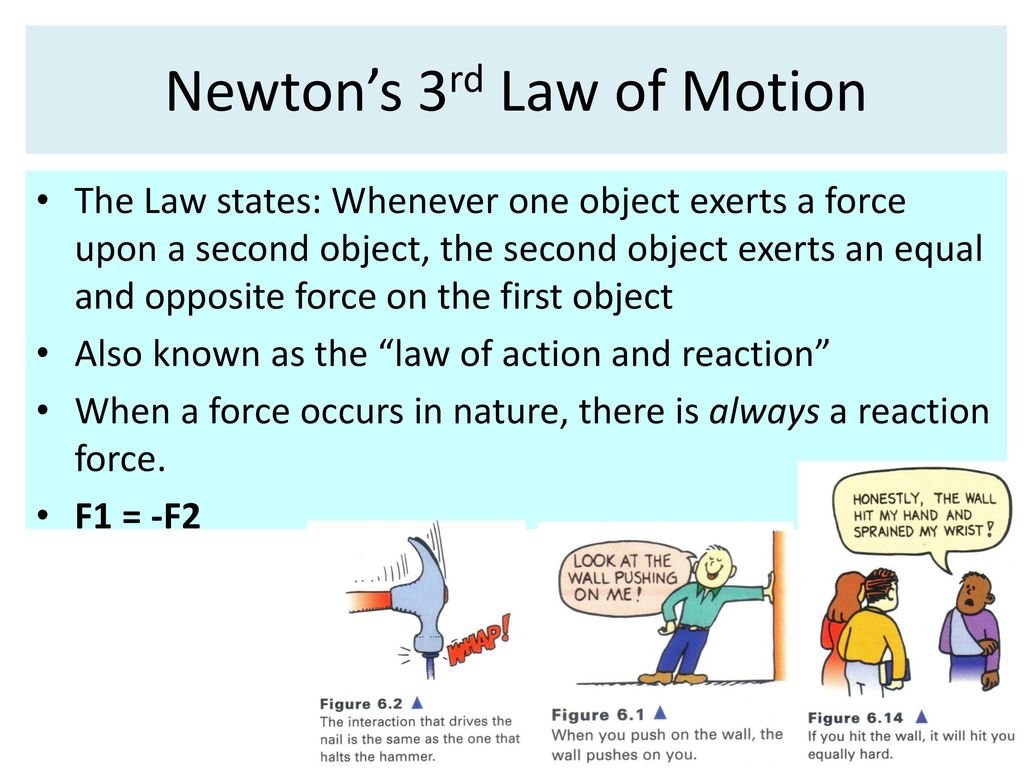
Action-reaction forces are described
in Newton’s third law of motion: for
every action force, there is an equal and
opposite reaction force.
Newton’s Third Law of Motion
Each
of these situations involves action-reaction
forces. The downward force
a diver puts on a board is an action
force. The upward push that propels
the diver into the air is a reaction force.
Action-reaction forces are described
in Newton’s third law of motion: for
every action force, there is an equal and
opposite reaction force.
Mass, Weight, and Gravity
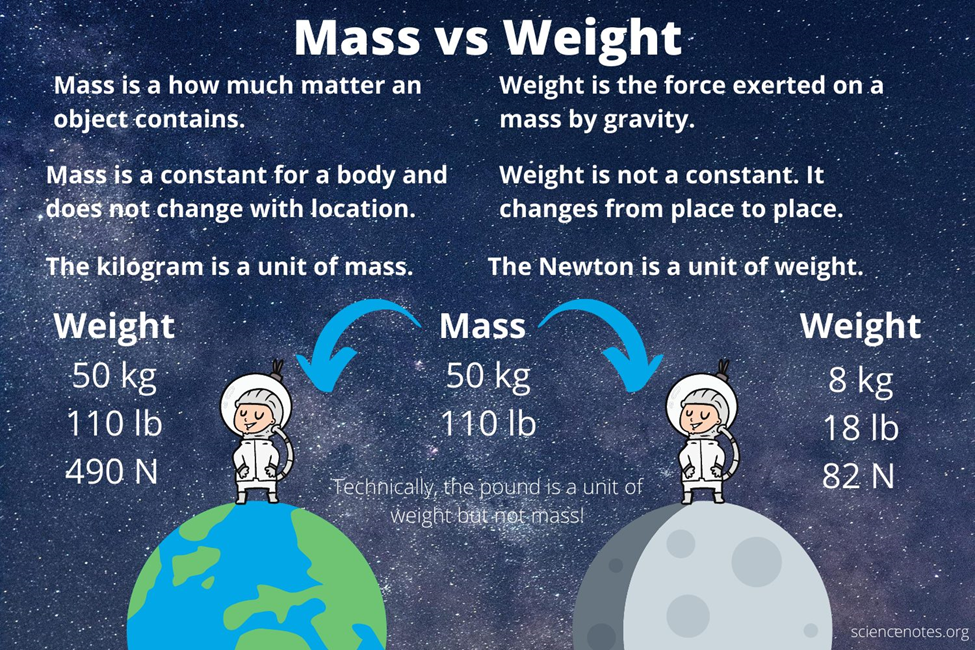
Mass and weight are different
properties. Mass is the amount of
matter in an object, and weight is the
force of gravity pulling down on an
object. Objects with more mass have
more weight. Although Earth and the
Moon both have gravity, Earth exerts a
far greater gravitational force than the
Moon, because Earth has much more
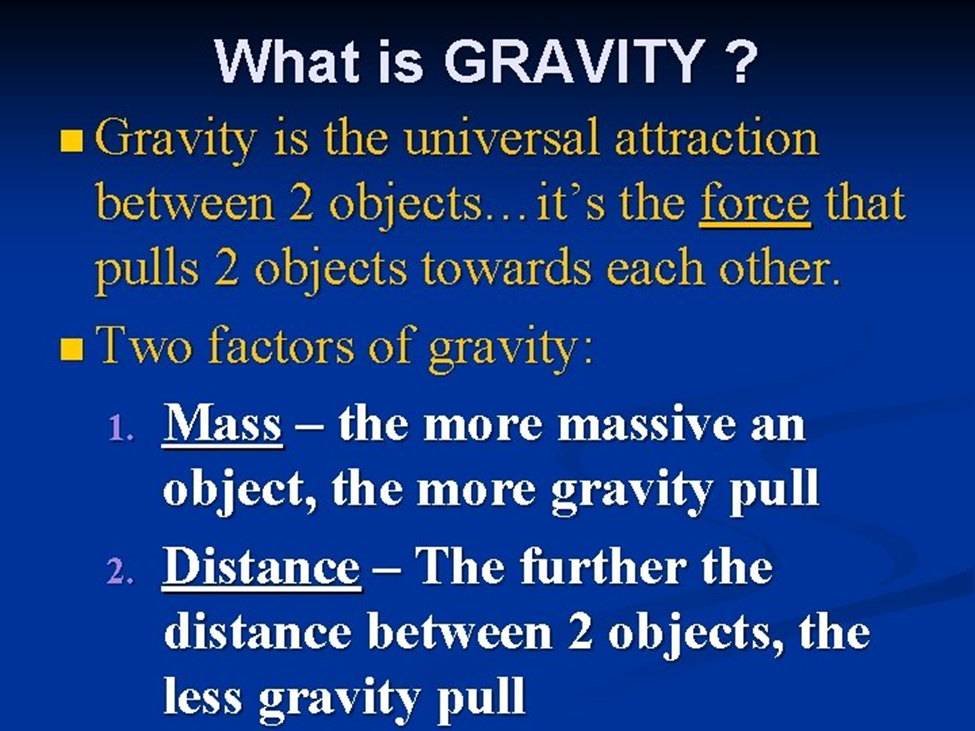
mass. The distance between objects
also affects the force of gravity. As the
distance between objects increases, the
force of gravity decreases.
Newton accurately concluded that
gravity can occur everywhere, not just
on Earth. He summarized this idea in
Newton’s law of universal gravitation.
According to this law, the planets, the
stars, and all particles of matter exert
gravitational force.
Work and Energy
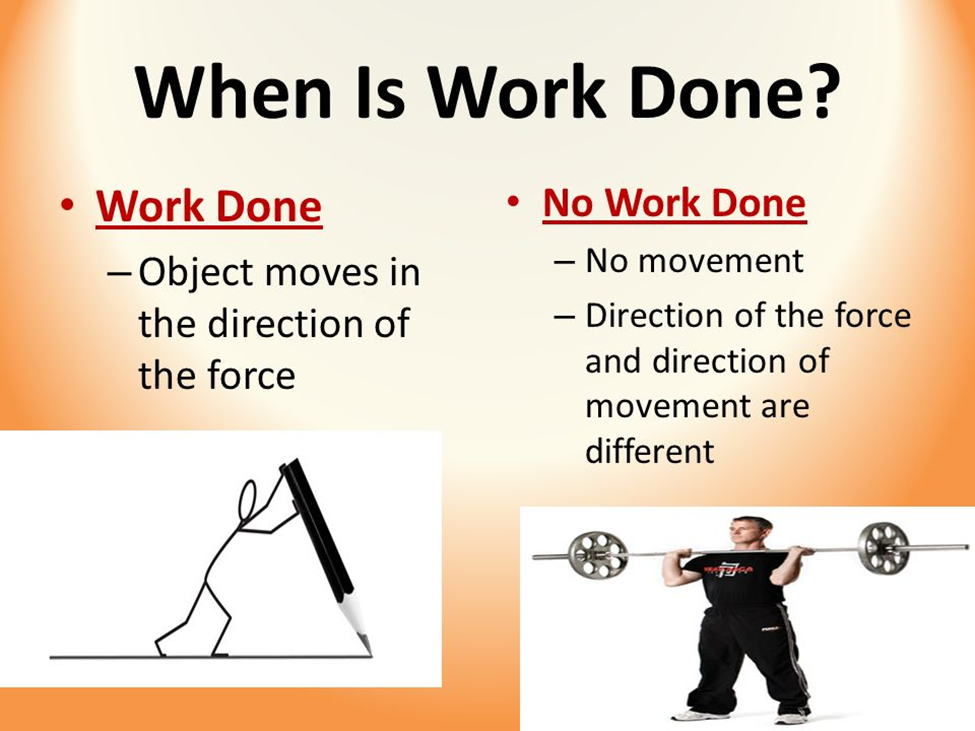
Scientists define work as what is necessary for a force to move an object through a distance.
When is work done?
Calculating Work
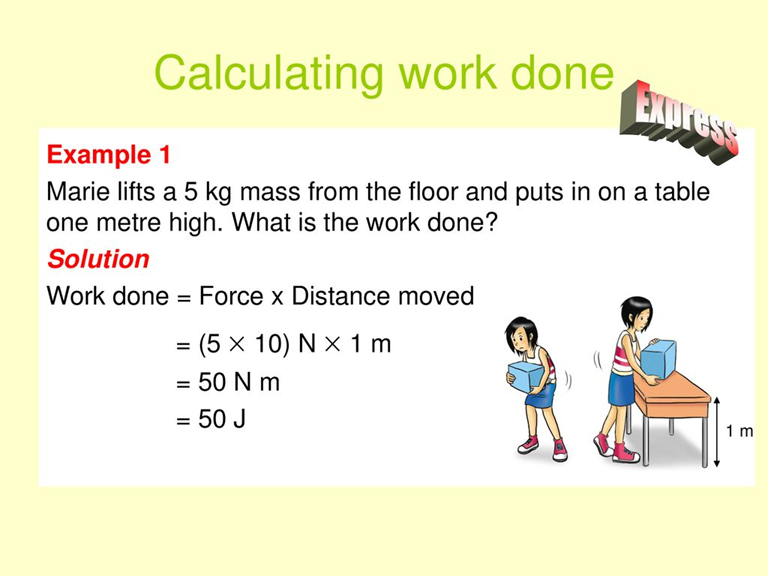
Work is equal to the force of a push
or pull multiplied by the distance the
object is moved. The force must act
in the same direction as the motion. If
the force is expressed in newtons and
the distance is expressed in meters, the
units for the work done are newtonmeters
(Nm), also called joules (J).
How does energy change form?
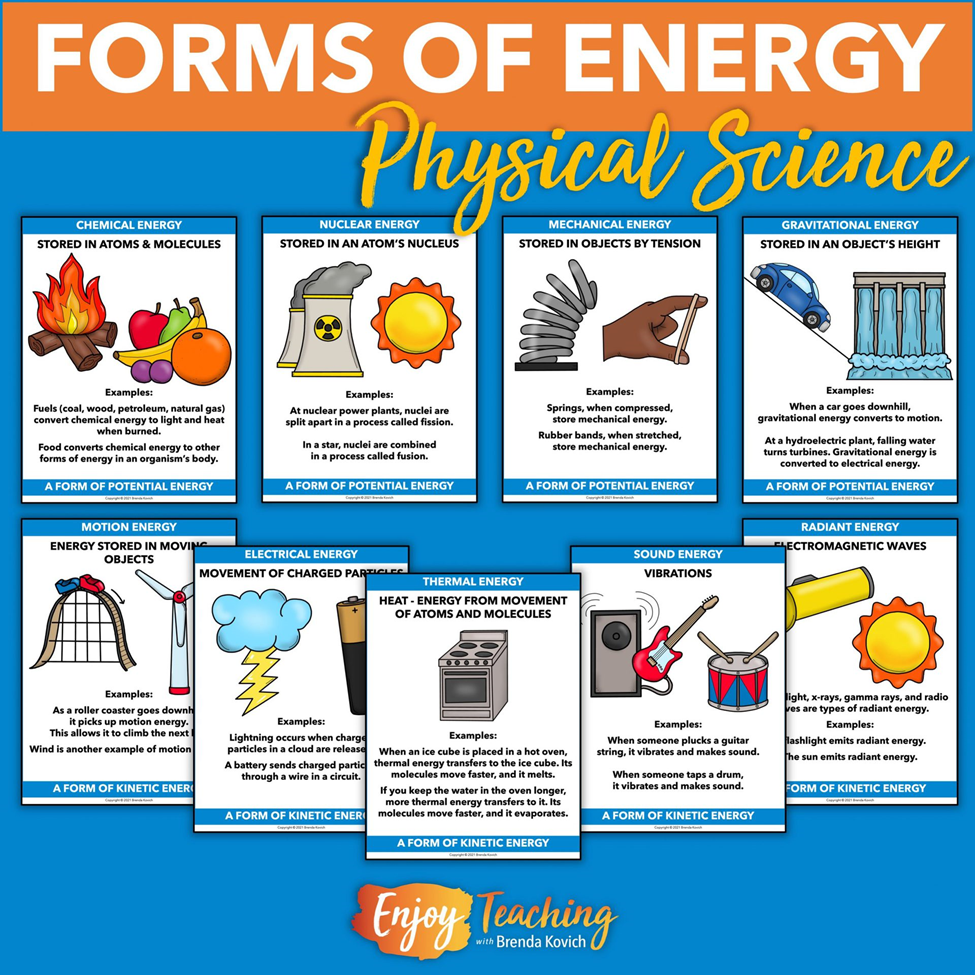
If work is to be accomplished,
energy is needed. Energy is the ability
to do work. Like work, energy is
measured in joules. Stretched rubber
bands or wound-up springs store
energy because of their elasticity. A
rock on the edge of a cliff stores energy
because of its position and the force
of gravity.
Potential energy is energy
that is stored. However, not all energy
remains stored. A moving object also
has energy, because it has mass and
speed. The energy of motion is called
kinetic energy. Objects with greater
masses or higher speeds have greater
kinetic energy. All energy is either
potential or kinetic.
Energy transformations
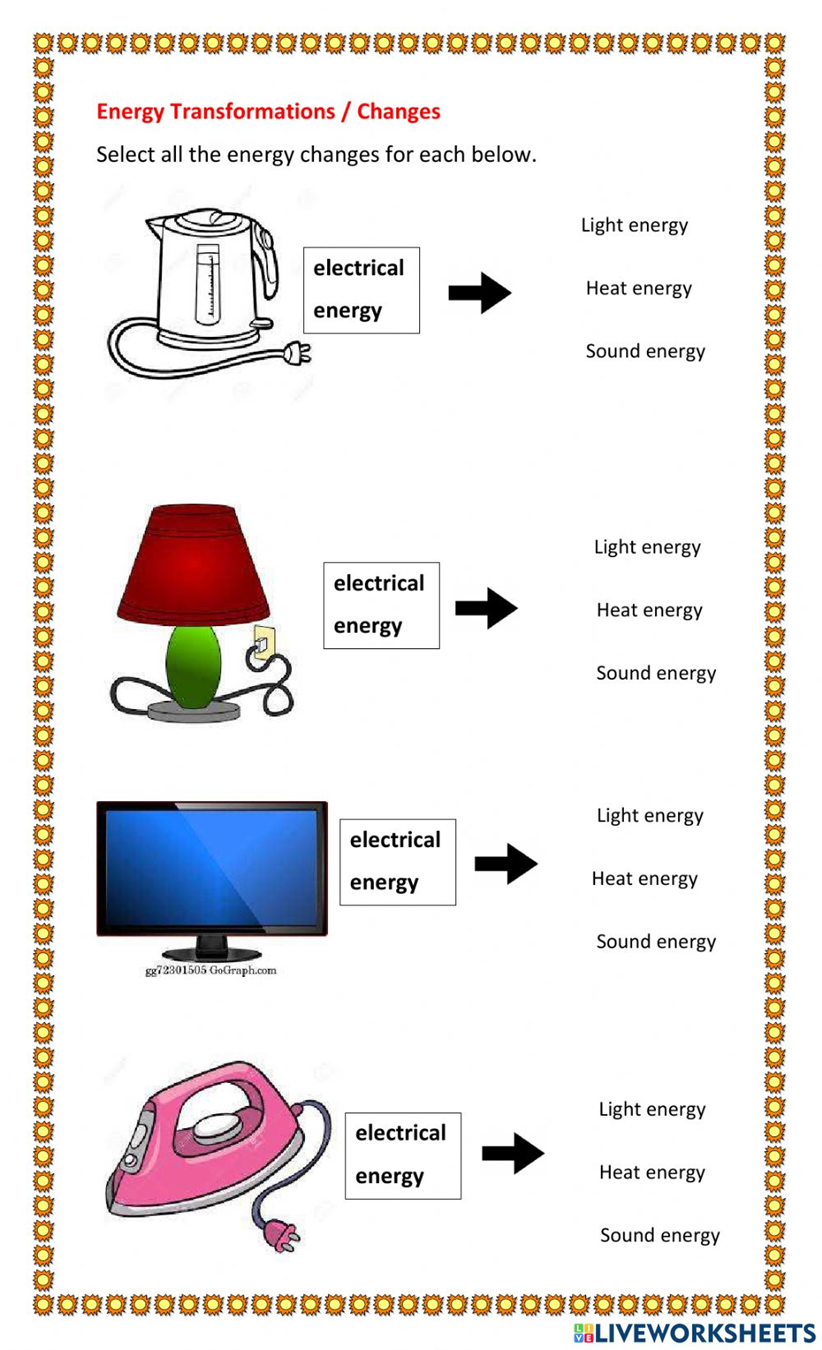
Energy often changes from one
form to the other. When a roller coaster
first moves over the top of a
hill, it travels slowly.
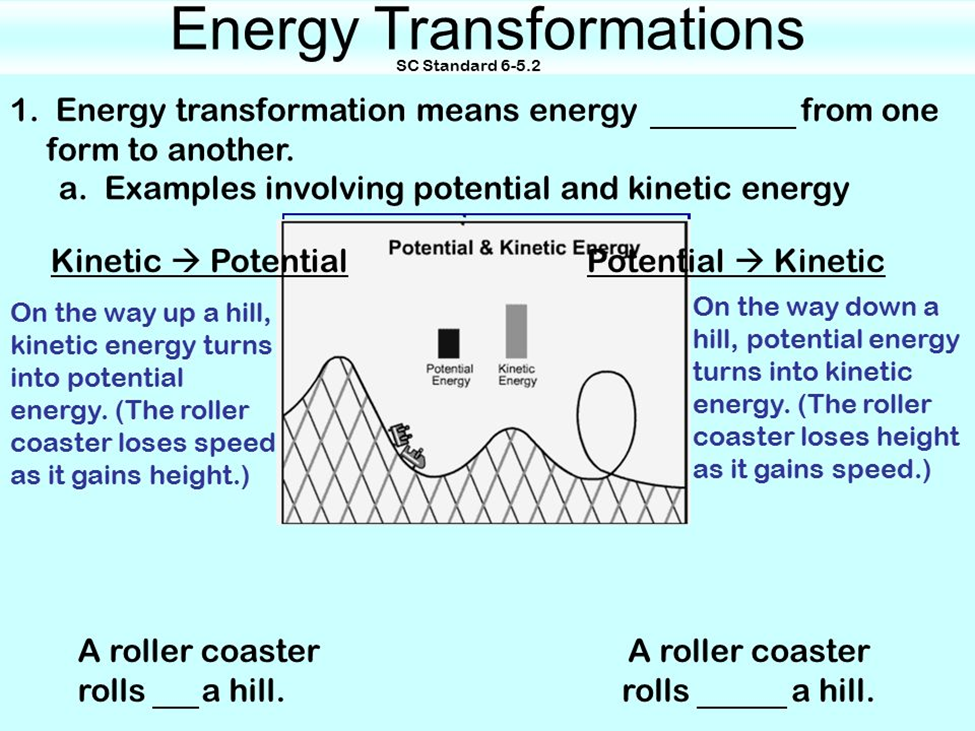
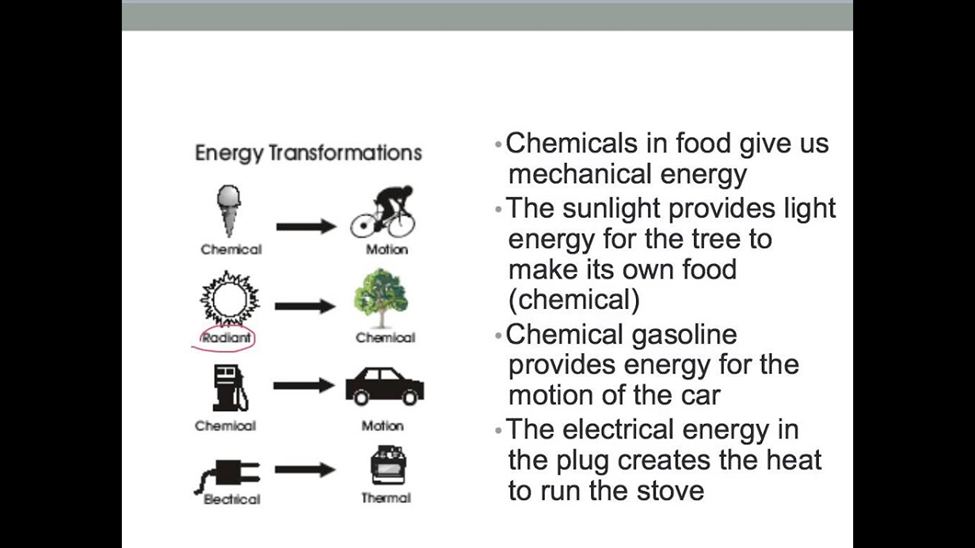
Most of its energy is potential energy.
A roller coaster speeds up as it starts
down the hill. At the bottom, the roller
coaster is at its highest speed. Most
of the potential energy is changed to
kinetic energy. However, this change
in energy is not the end of the ride.
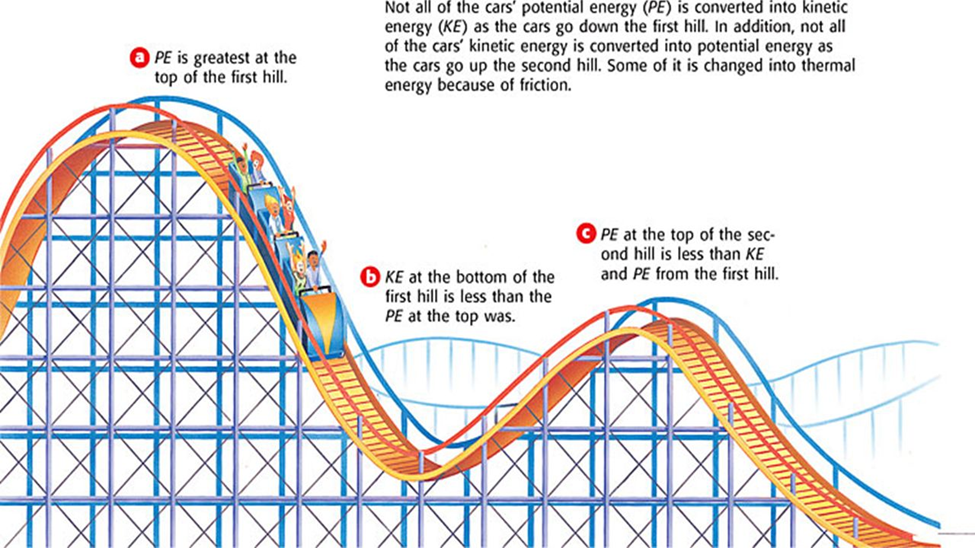
Thermal energy is the heat energy
in an object. Friction between the track
and the roller-coaster cars changes
some of the total energy to heat. This
thermal energy can warm the track,
but it cannot run the roller coaster.
Because some energy is wasted, the
roller coaster would not be able to
reach the top of the next hill if it were
as high as the first one. This explains
why the first hill is always the tallest.
Conservation of Energy
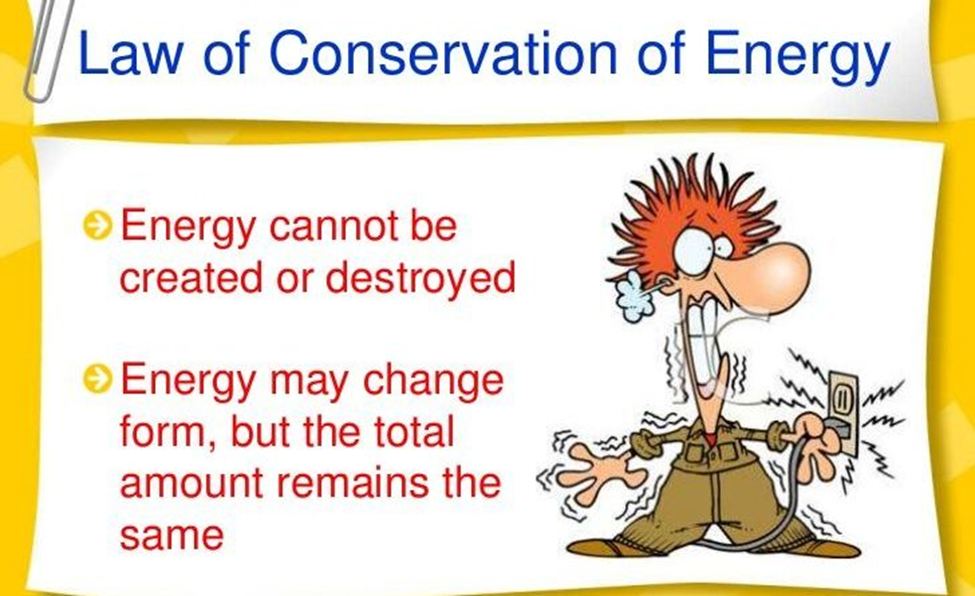
Energy does change from one
form to another, but energy cannot
be created or destroyed. Scientists call
this the law of conservation of energy.
Forms of Energy
Form Example of Source
nuclear the Sun, radioactive material
chemical food
electrical a generator, a battery
light the Sun, an electric lamp
mechanical moving parts in a machine
sound vibrations of a stereo speaker
thermal hot water in a radiator
What is power?
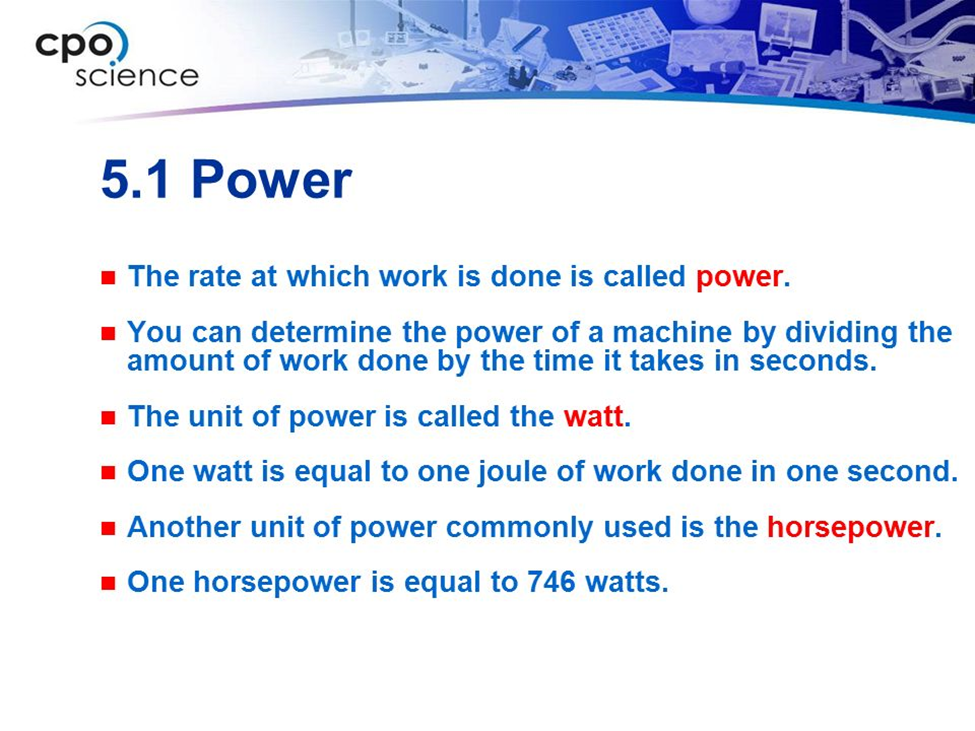
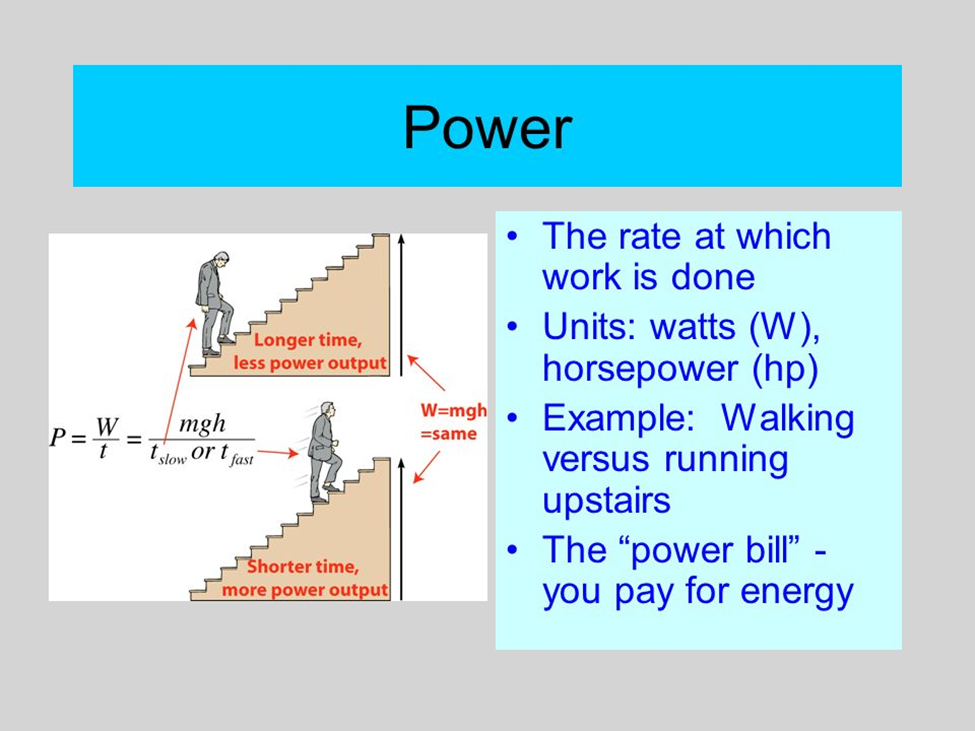
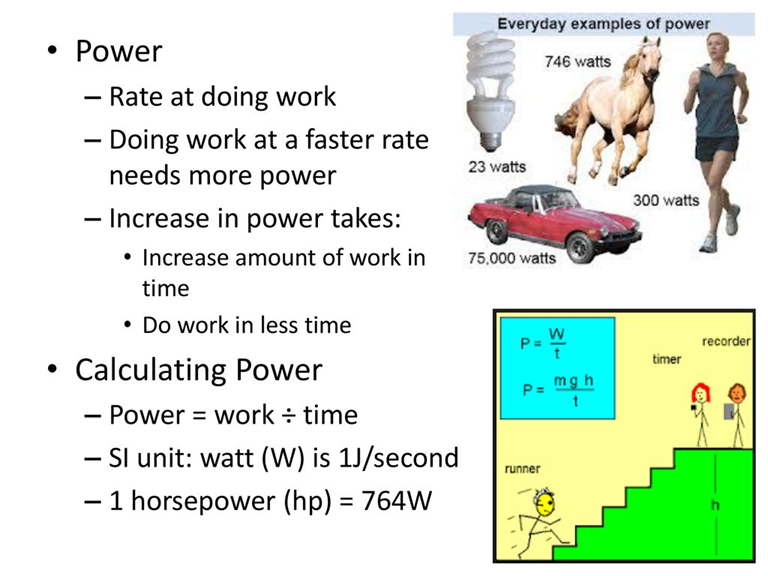
The amount of work
done per unit of time, or work divided
by time, is called power. The elevator
moves you to the top floor much faster,
so the elevator has more power than
you do.
If work is expressed in joules and
time is expressed in seconds, then
power is expressed in joules per second
(J/s). One joule per second is also
known as a watt (W). The watt is the
standard unit of power.
Calculating power
Suppose you moved a wagon 5
meters. The task required 400 joules of
work and took 20 seconds. What is the
power for this task? You can calculate
power by using the following formula:
power = work ÷ time
power = 400 J ÷ 20 s
power = 20 J/s = 20 W
Light-bulb labels indicate the power
the device uses per second. The more
power a light bulb has, the brighter the
light bulb is. Household bulbs has about
100 watts or less of power. Kilowatts
(kW) measure large amounts of power.
The prefix kilo- means “one thousand.”
A kilowatt is 1,000 watts of power.
Horsepower (hp) is a measurement
of power as well. More than 200 years
ago, James Watt invented this unit to
compare the power of a machine to the
work done by a horse. A horsepower
equals 746 watts. The watt as a unit of
power is named in honor of James Watt.